文明之旅
First regular Arctic container service China-Europe Arctic Express set to debut this week, ship operator tells GT_我的网站

一 |
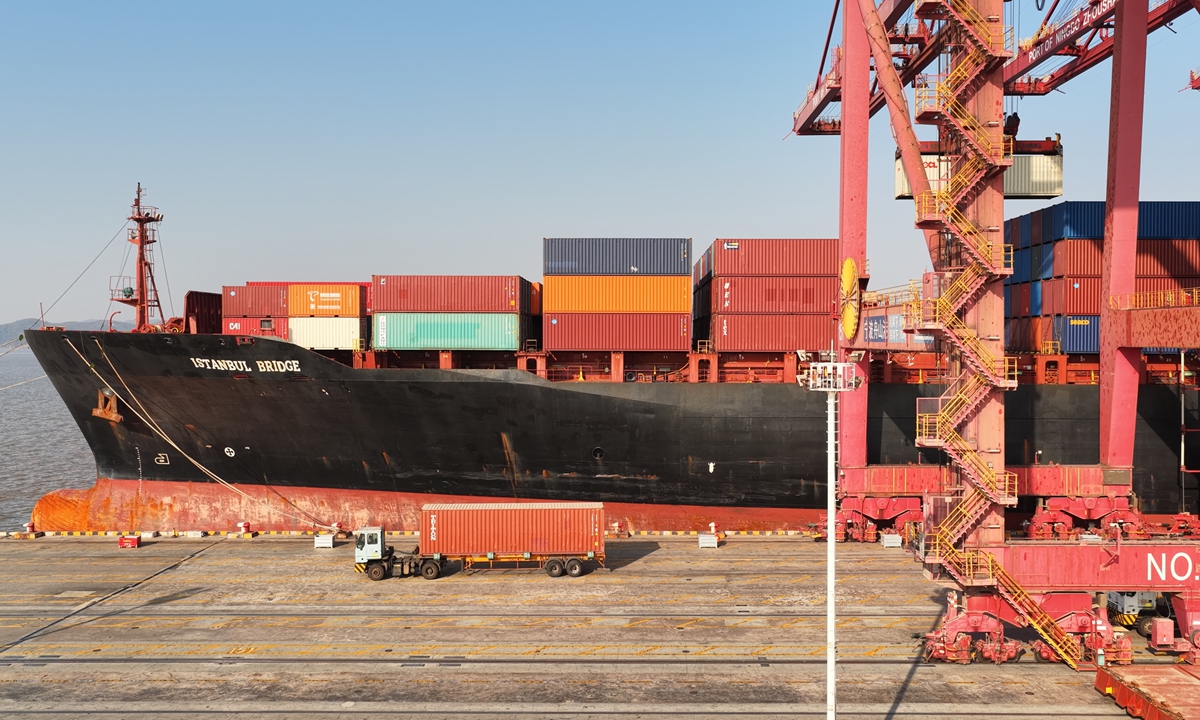
A Chinese shipping company has confirmed with the Global Times the plan to launch a regular container service via Russia's Northern Sea Route to Europe this week, marking a new Arctic option for Asia-Europe trade once it sets sail.
Chinese container shipping company Sea Legend Shipping told the Global Times on Tuesday that its vessel Dubai Tower, originally scheduled to depart Ningbo-Zhoushan Port in East China's Zhejiang Province, on August 15, has had its departure adjusted because of weather conditions. The company said it is making internal arrangements for the maiden voyage of the China-Europe Arctic Express Route.
According to industry observers, the move reflects growing interest in Arctic shipping as global logistics networks continue to diversify beyond traditional canal routes. As polar ice retreats and seasonal navigation windows widen, the Arctic is emerging as a practical alternative for some Asia-Europe shipments, particularly those seeking to avoid congested or geopolitically sensitive sea lanes.
On Monday, the Financial Times reported that Sea Legend would launch the first regular container shipping service through the Arctic this week. The report said the company has branded the service the "Ice Silk Road," a reference to the historical Silk Road linking China and Europe.
The move comes as Arctic shipping increases amid rapidly shrinking sea ice. The Northern Sea Route recorded a record 23 transits last summer, up from 15 in 2024, according to figures cited by the FT.
Sea Legend told the Global Times that, compared with traditional China-Europe routes that can take around 40 days, the Arctic passage could cut transit time by nearly half, reducing the journey to about 20 days under direct service conditions.
The inaugural voyage is expected to call at Qingdao Port, Shanghai Port, Taicang Port and Ningbo-Zhoushan Port in China before continuing to European ports including Teesport and Felixstowe in the UK, Hamburg in Germany and Gdynia in Poland. The final domestic calling sequence may still change due to typhoon-related weather conditions.
The service will carry cargo including energy storage containers and related components, power batteries and new energy vehicles - goods that typically require faster transit, stable schedules and controlled transport conditions.
Sea Legend said the Arctic route could offer exporters a new solution in terms of both speed and reliability, as traditional canal and mainline routes face growing uncertainty from congestion, geopolitical disruptions and longer port waiting times.
The company also said the route has cooperation agreements with destination terminals including Felixstowe, Rotterdam, Wilhelmshaven and Antwerp, giving vessels priority berthing and a "green channel" advantage that could reduce anchorage delays and logistics costs.
Zhong Zhechao, an international logistics service expert told the Global Times on Tuesday that the move highlights rising interest in using the Arctic region for shipping, with Arctic shipping gradually becoming a practical alternative in the global logistics network as melting ice expands seasonal navigation windows and shipping lines seek to avoid congested and geopolitically sensitive sea lanes.
For exporters - especially cross-border e-commerce firms, manufacturers of seasonal products, and new energy companies - shorter shipping times could ease inventory pressure and reduce working-capital costs by allowing more flexible production and sales planning.
Zhong said this may be particularly valuable for companies racing to meet European sales seasons, as shorter transit times improve responsiveness to overseas demand.
The company also said the Arctic's low-temperature environment may be especially suitable for transporting new energy products such as batteries and energy storage systems, which require heightened attention to safety and thermal-risk considerations during transit.
Looking ahead, Sea Legend aims to achieve roughly four months of stable annual operation within the next three to five years, with a longer-term goal of year-round Arctic navigation within five to ten years.
The launch underscores how Chinese shipping firms are accelerating their Arctic deployment, turning what was once a long-term vision into operational reality.
According to the Xinhua News Agency, in September 2025, Ningbo-Zhoushan Port launched its first China-Europe Arctic container express route. The move was expected to provide strong support for trade enterprises to expand into new international logistics channels, the port said.
In recent years, Arctic shipping routes have increasingly come under the spotlight in the international community and have the potential to become important routes in international trade, Lin Jian, Chinese Foreign Ministry spokesperson, told a press conference in September 2025.
China stands ready to work with Russia and other Arctic states as well as interested countries to strengthen international cooperation on the building and operation of basic infrastructure along Arctic shipping routes and jointly advance the development and exploration of the routes and protect the environment there, Lin said.
。 8月24日消息,IBM的大型机依然是很多银行、保险企业的核心设备,使用的也是IBM自研的Z系处理器,在日前的HotChips大会上IBM又宣布了全球首款双架构的大型机处理器。 IBM的大型机一直是独立的生态系统,但是现在ARM+Linux生态发展势不可挡,IBM不想失去这个市场的话就得支持ARM,但他们也不可能马上放弃自己的Z指令集,所以就有了这个可以切换架构的处理器。

二 | 根据IBM的说法,这个处理器可以原生支持ARM及自己的Z指令集,并且可以纳秒级切换,该机制依赖于开源的KVM hypervisor,企业可以并行运行Arm64 Linux虚拟机和在Z虚拟机上的Linux,虚拟机管理程序调度虚拟机到物理核心时核心会自动切换模式,而且性能惩罚几乎是0,纳秒级延迟,实际几乎体验不到切换开销。 IBM没有明确这款芯片的具体明确,只公布了是2nm工艺,11核CPU架构,频率高达5.7GHz,会用于下一代大型机,预计是在2028年问世。 不过IBM所说的这一切还都是纸面上的,大型机的真实工作环境要求极高,能不能做到IBM所说的这样几乎无延迟切换、兼容性也不是问题,还得在未来几年中逐渐验证。 这款处理器的技术意义是非凡的,以往的双架构处理器也不是没有,但各自都是独立的,IBM是在内核层面做到了两种指令集切换,几乎没有延迟,毕竟大型机对工作可靠性的要求是极高的,这点上IBM需要保证不出问题。 这种双架构处理器不知道是否还会有其他公司跟进,估计是很难的,因为其他公司不一定有这样的需求,AMD/Intel的x86本身就能跑Linux系统,去兼容ARM指令集意义也不大,大部分企业都是选择一个指令集,也没有兼容2种指令集的需求。

三 | 国产的一些自研处理器倒是有这样的需求,但是这个设计又要考虑技术难度,还要考虑指令集授权,有需求的也做不到这一点,总之IBM在这个方向上应该是前无古人后无来者了,比他们强的没必要学,想学的又没IBM的本事。

四 |
Current article:http://7u2.senchuoshaozaodidia.shop/news/20260826_666214.html
Published on:18:12:07
 公主小妹
公主小妹 微博
微博 大明王朝1566
 锦衣卫
锦衣卫 legal high
 天地传说之鱼美人
 日历
日历 律政英雄
律政英雄


